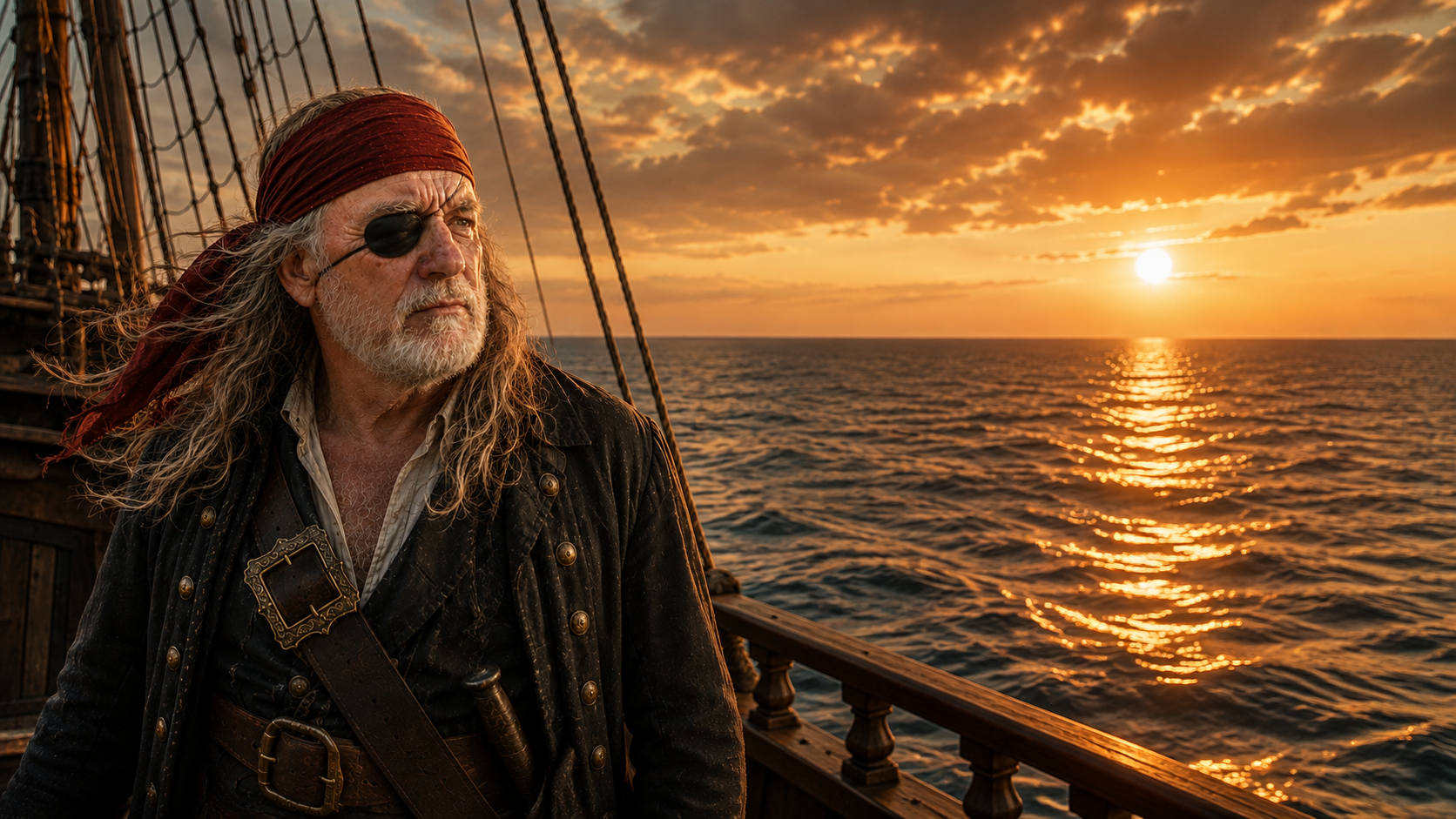
Last week Sean and I were doing what we often do when the house gets quiet. The dogs were settled in, Debbie had already gone to bed, and we were sitting up talking with music playing in the background. At some point Jimmy Buffett’s A Pirate Looks at Forty came on, and we laughed and sang along. We were both sipping a little rum, so it fit the moment perfectly.
Later, after Sean had gone to bed, I was still sitting there by myself with that song in my head. Somewhere in the quiet, I caught myself thinking, Maybe I’m a pirate looking at 70.
I’ll be 67 this year. Seventy is close enough now that I can see it on the horizon.
That thought stayed with me because it made me realize how differently I look at life today than I did when I was younger. When you’re young, you tend to believe life will be defined by the big things—the career, the accomplishments, the titles, and the milestones. And those things matter. They help shape who we become. But the older I get, the more I realize that the things I treasure most today aren’t the things I spent the most time chasing when I was younger.
They’re the moments.
The people.
The conversations.
The roads I never planned to travel.
I grew up in a military family. My father was a Command Sergeant Major in the Army, and money was often tight. We were a family with four kids, plenty of hand-me-down clothes, and very little concern for whether those clothes happened to be in style.
What made it more noticeable was that we weren’t living on a military installation surrounded by other military families. We lived in Little Rock, Arkansas, in a civilian neighborhood where many of the families were more affluent than we were. I wasn’t surrounded by other military kids who understood that lifestyle. I was simply the kid wearing clothes that looked like they came from another decade.
Kids noticed.
And kids can be cruel.
At the time, all I knew was that I hated being different. Looking back now, I can see those experiences built something in me. They taught me determination. They taught me that circumstances didn’t get the final vote. Most importantly, they taught me that being underestimated can become a powerful source of motivation if you’re willing to keep moving forward.
Years later, another event changed the course of my life. In the middle of my senior year of high school, my father received orders and our family moved to Germany. At the time, it felt like I was losing everything—my friends, my routines, and the life I had spent years building. What I didn’t know was that Germany was about to give me far more than it took away.
Because Germany is where I met Debbie.
At the time, she was simply a young woman I met while our families were stationed overseas. What I couldn’t possibly have known then was that meeting her would shape every chapter that followed. The life I treasure today—our marriage, Sean, Chris, and the family we’ve built together—can all be traced back to a move I never wanted.
Sometimes the things that feel like interruptions become the things that shape your entire life.
Years later, after Debbie and I had built our own family, I started making regular trips to visit my parents. My mother’s health had declined significantly by then. Kidney disease and lung disease had slowly taken away much of her independence, and she spent most of her days sitting at the kitchen bar watching episode after episode of Law & Order. By that point, being on oxygen had simply become part of everyday life for her.
Whenever I could get away from work, I’d make the trip to Oklahoma. Sometimes it meant driving across multiple states just to spend a few days sitting in that kitchen. We didn’t do anything remarkable. We didn’t go sightseeing. We didn’t have grand adventures. Most of the time we simply talked. She told stories about growing up, stories about Army life, stories about raising four kids, and stories about my father that I had never heard before.
I can’t remember most of the television episodes she watched.
I remember the conversations.
At the time, those visits felt ordinary.
Today, they’re priceless.
What I didn’t understand then was that I wasn’t making trips to see my mother. I was collecting memories that would stay with me for the rest of my life.
When my mother’s health took a turn for the worse, I began flying back and forth more often. During the final year of her life, it seemed like she spent as much time in hospitals as she did at home. One day my father called and asked if I could come help. My mother was expected to be released from the hospital, and he needed time to prepare the house and get things ready for her return.
I flew to Oklahoma and went straight to the hospital.
My mother couldn’t speak much by then, but when she saw me she reached out, took my hand, and smiled. My father had been there for days and was exhausted. We both eventually fell asleep in chairs beside her bed.
A nurse woke me.
She told me to wake my father and get him out of the room.
My mother was about to code.
I woke him, and we had barely stepped out of the room when the alarms began sounding behind us.
My mother passed away that night.
Looking back, I’ve often wondered if she was waiting until someone arrived to help take care of my father before she let go.
I don’t know if that’s true.
But I’ve thought about it many times.
After she passed, my focus shifted almost entirely to him. There were funeral arrangements to make, family members to contact, and decisions that had to be handled. While I was grieving too, much of my energy went into helping my father carry the weight of losing the woman he had spent his life with.
Eventually he found his footing again.
Then one day he told me something simple.
“There are still places I want to see.”
That statement changed the next several years of our lives.
Whenever I could, I’d take time off and we’d travel together. We visited the Black Hills, Mount Rushmore, Crazy Horse, and Deadwood. At Deadwood, he wanted to visit the cemetery where Wild Bill Hickok and Calamity Jane were buried. By then he couldn’t make the climb up the hill, so I walked up with my camera, took pictures, and brought the experience back down to him.
The trip that stays with me most, however, was Washington, D.C.
For a man who had spent fifty years serving his country—thirty years in uniform and another twenty in government service—he had somehow never been there. Of all the places we visited, the one he cared most about was Arlington National Cemetery.
We rode the visitor shuttle through the grounds and eventually made our way to the Tomb of the Unknown Soldier. The ceremony was everything you’d expect: precision, discipline, dignity, and respect. I spent most of the day taking photographs, trying to capture every detail. Then, somewhere during the changing of the guard, I stopped taking pictures and simply watched.
As the ceremony unfolded, I turned and looked at my father.
For my entire life, he had seemed larger than life. Strong. Confident. Unshakable.
But standing beside me that day was a small gray-haired man leaning on a cane.
Time had done what time always does.
Yet when the moment came, he stood as straight as he could. As the guards rendered their salute, my father raised his hand and returned one of his own.
I missed the photograph.
But I’ll never forget the memory.
That moment taught me something important. The people who seem permanent when we’re young aren’t permanent at all. They grow older. They slow down. Their world becomes smaller. And if we’re fortunate enough to have enough years together, we eventually get the opportunity to appreciate them not for the role they played in our lives, but simply for who they are.
Then came one of the hardest chapters of my own life.
The illness.
The infection.
The decision to amputate my leg.
For more than a year, Debbie and I lived in a cycle of appointments, wound care, antibiotics, and hope. Every improvement felt like a victory. Every setback felt like starting over. I fought hard to save my leg, and my doctors fought right alongside me.
Then one day a doctor I trusted sat down and said something I’ll never forget.
“Don, if you were my father, I’d tell you to take the foot.”
It wasn’t what I wanted to hear.
But deep down, I knew he was right.
For more than a year I had been trying to save something that was keeping me from living. My world had become smaller and smaller. I couldn’t travel. I couldn’t ride. I couldn’t walk normally. Every day revolved around treatments and recovery.
What I thought I was protecting was slowly taking away the life I wanted to live.
So I made the decision.
It was one of the hardest decisions I’ve ever made.
It was also one of the best.
Not because losing a leg is easy.
Not because I wanted it.
But because it became the first step toward getting my life back.
The more I reflect on the road behind me, the more I see a pattern. Many of the experiences that shaped my life arrived disguised as something else. The move to Germany looked like loss until it gave me Debbie and my family. The time spent sitting at the kitchen bar with my mother seemed ordinary until it became one of my most treasured memories. The trips with my father looked like vacations until I realized they were opportunities to create moments that would never come again. Even the amputation that felt like an ending eventually became the beginning of a new chapter.
Maybe that’s what I was thinking about that night while Buffett played in the background.
Maybe that’s what a pirate looking at 70 sees.
Not a life without hardship.
Not a life without mistakes.
Not a life where everything worked out according to plan.
Instead, a life filled with unexpected turns, difficult roads, and blessings that often arrived wearing a disguise.
I even had a little fun with the idea and created an image of myself as an old pirate staring out at the ocean. It made me laugh when I first saw it. But the longer I looked at it, the more it felt true.
Because when I look back now, I don’t think first about titles, promotions, or accomplishments.
I think about my mother sitting at that kitchen bar.
I think about my father standing at Arlington.
I think about Debbie.
I think about Sean and Chris.
I think about the people who traveled those roads with me.
The things I treasure most today were rarely the things I thought were most important when I was younger.
And for all of it—the hard roads, the unexpected turns, and the blessings I never saw coming—I’m grateful.
And I’m still moving.
Leave a Reply